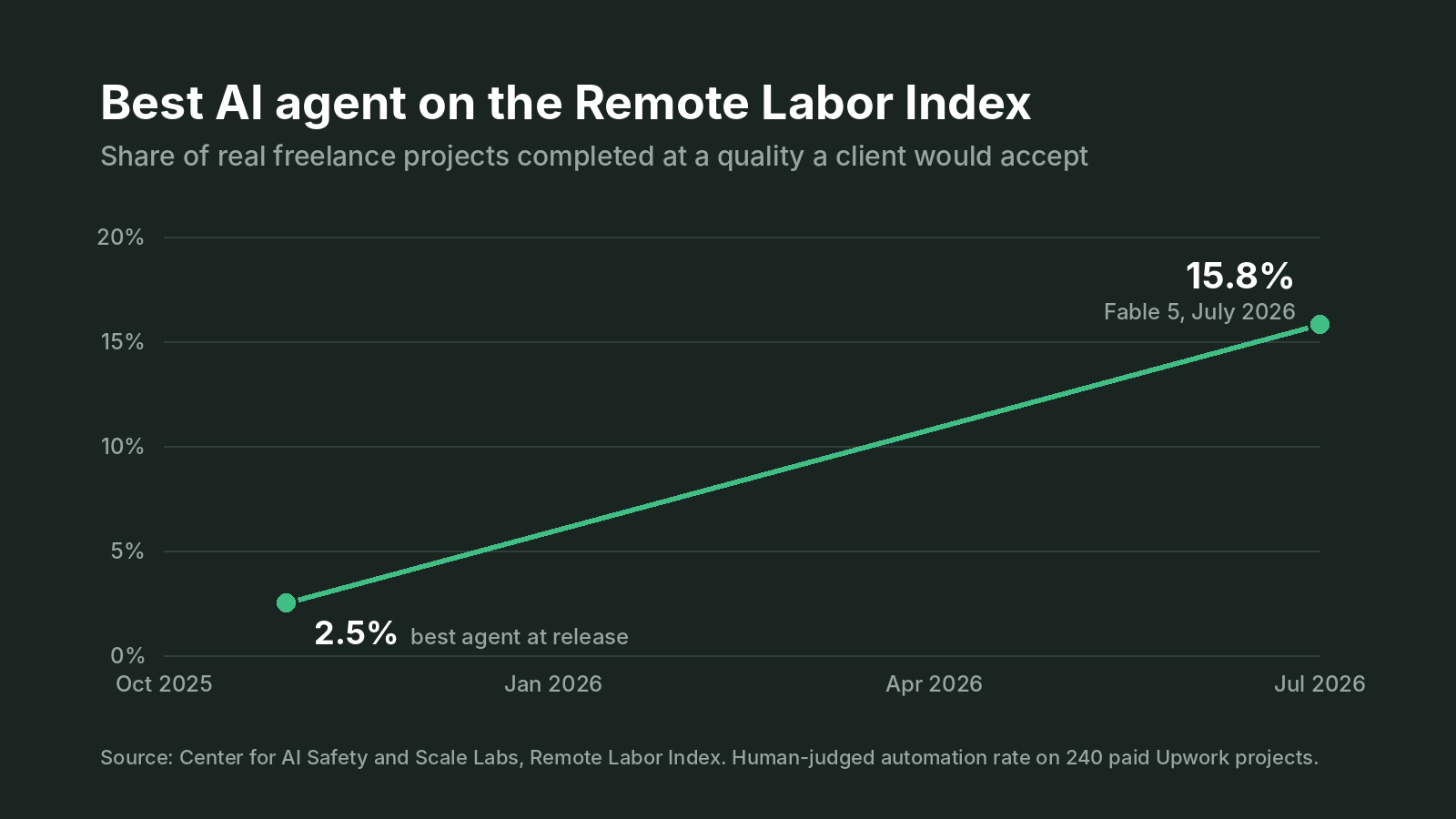
In February I wrote that AI fails at about 97% of real remote jobs. The Remote Labor Index, built from 240 paid freelance projects, scored the best agent at 2.5%. My takeaway then: AI speeds up the steps, and the final handoff stays human.
By July the scores had moved. The Center for AI Safety published new results: Fable 5 reached 15.8%, Opus 4.8 8.3%, GPT-5.5 6.3%. More than six times the original best in under a year. Since then, Scale’s leaderboard shows the top score past 21%. Most projects still fail.
The same update carried a warning. The researchers’ own AI judge overstated the newest models’ scores by 2.3 to 2.9 times. Catching the flaws meant opening the files and knowing what to look for. As output gets better, it gets harder to check.
So the tools keep getting better and still need a person beside them. That makes the training the real work, and it never quite ends. I asked seven people who led it what surprised them, who adapted, who struggled, and what they’d change. They are founders, CEOs and consultants, so this is the view from the people who brought AI in. Their staff might tell it differently.
Experience cuts both ways
The clearest pattern in the answers is that experience helped some people and slowed others. It brings two traits that pull in opposite directions.
One is judgment: the ability to look at an answer and know it’s wrong. The other is attachment to a way of working that the tool now does for you. A senior person usually has both. Which one shows up first decides whether they look like a fast adapter or a holdout.
Scott Stouffer, co-founder and CTO of Market Brew, saw the hard version of this. “Engineers struggled the most. We’ve had to let some go and refocus our hiring efforts towards those who used AI to leverage and automate their work.” His biggest surprise was “how much of our identity as software engineers was tied to writing code.” For his engineers, the attachment ran deeper than a workflow.
Igor Ivitskiy of Doctor Ads saw the two traits separate among the PPC specialists he works with. His fastest adapters “had always asked why an account behaved the way it did.” His slowest were the ones best at pulling the levers the software now pulls. Ivan Vislavskiy, co-founder and CEO of the Chicago agency Comrade, saw the other half. His newer staff “shipped polished work that was subtly wrong, because they couldn’t yet tell good from bad.” Little attachment to slow them down, and too little judgment to catch the errors. That’s the benchmark’s checking problem, on a real team.
So years on the job predict less than which trait a person leans on.
The attachment is real, and worth respecting
Where experience slowed people down, the leaders describe fear and loss more than stubbornness.
Rahul Agrawal, founder of QuickIntell, trains front-desk and billing staff at medical practices when his company deploys AI agents there. The veteran billers struggled most: “watching an agent do the first 80% felt like losing the part of the job they were proud of.” Newer staff “treated the review queue as the job rather than as a demotion.” Same tool, different stakes.
Maksym Ivanov, CEO of Aimprosoft, had a senior engineer who resisted for a year. Two months of hands-on use changed his mind, and he “came back telling me he was worried AI would take over his own work.” Chris Raulf, founder of Boulder SEO Marketing, had a senior writer refuse the tools for six months, worried they’d make her work less creative and eventually replace her. She came around once she saw AI take the research and formatting she disliked and leave the strategy to her. In both cases, direct experience with the tool moved them.
The real failure shows up after people adapt
Resistance is loud and early. The expensive problem is quiet and late, and it mirrors the benchmark.
Chris named it: “resistance wasn’t the hard part. Complacency was.” Early AI drafts were obviously flawed, so everyone checked them. Once the output improved, people edited less and accepted more, and the work drifted toward “plausible but generic.” He only noticed because the posts stopped sounding like him. This is the benchmark’s lesson inside one company: as output gets better, the errors get harder to see, and the checking quietly stops.
The other late failure is silent abandonment. Lilach Bullock, an AI implementation consultant, watched a client go from 35 of 40 staff trying the tool in week one to 11 using it regularly by week six. The ones who struggled “just went quiet rather than complain.” Two floor champions, whose only job that quarter was answering questions inside the tool, brought it back to 29.
Both problems stayed invisible until someone went looking. Neither showed up in week one, which is exactly why a one-time rollout misses them.
What they’d change
The advice converges on two things.
The first is building the checking habit before the tools. Igor’s rule is to “teach verification before generation”: people prove a tool wrong on a live account before they rely on it. Chris puts one human review step before anything publishes, and builds a knowledge base of real material before anyone learns prompting. Rahul trains staff on the practice’s own first-week cases.
The second is giving every gap an owner. Rahul names who handles what the agent can’t finish before go-live. Lilach puts champions in on day one, before usage drops.
One policy worth copying
Scott’s company, Market Brew, has an internal AI content policy. He shared the short version.
-
If you send it, publish it, present it, or put your name on it, you own it. You should be able to stand behind every material idea and sentence.
-
Writing is thinking. AI can help brainstorm, challenge, draft, edit, and proofread, but it should not be used to skip the reasoning itself.
-
Respect the reader’s time. A short prompt can create pages of text in seconds, but several people may then have to spend time reading it. The author should do the work of editing and compressing.
-
Longer is not better. Remove repetition, filler, generic transitions, and anything that does not materially change what the reader understands or does.
-
Rewriting is not lossless. AI can subtly change emphasis, certainty, nuance, and meaning. Make sure the final version still says exactly what you intended.
-
Raw AI output is fine when clearly labeled as such. For example: “ChatGPT suggested this approach. Do you think it’s worth exploring?”
If you’re running a rollout
Decide who checks the output before you decide which tool to buy. Expect your experienced people to split two ways, and respect what the change takes from the ones it slows. Then plan for the quiet months, when the output looks good enough that people stop reading it. As the benchmark shows, better output is harder to check.
Till next time 👋
Ilias