Note: This post summarizes and comments on Understanding ChatGPT Citations: Evidence from Production Web Search Across Model Generations by Yunxuan Jiang, Shiqi Zhang, Anqi Xing, Xiangyu Chang and Xiaokui Xiao. It is an arXiv preprint and has not been peer-reviewed. I did not conduct the original research. This is my summary and commentary.
In July I wrote about Semrush’s AI Visibility Index and the gap between being mentioned and being cited. This paper looks one step earlier: the gap between the pages ChatGPT retrieves and the pages it cites.
The researchers recorded ChatGPT’s own search traces in their signed-in sessions. That showed the queries it actually ran, every page it retrieved and which pages it picked as sources. They used 80 real user questions from Search Arena, a public dataset, and ran each one 20 times on GPT-5.3 and GPT-5.5 Instant between March and July 2026. GPT-5.2 Instant and GPT-5.4 Thinking were also tested, on fewer questions, because they were retired mid-collection.
Search Engine Journal covered the headline numbers on how well Google and the OpenAI API stand in for ChatGPT. I want to focus on the part of the paper that got less attention, and what it changes in how I measure visibility for clients.
Two filters
On a typical Instant answer, ChatGPT retrieved around 20 main search results and selected about 6 sources, counting the supporting pages attached to them.
So a page passes two filters. First it has to be retrieved. Then it has to be picked. The authors call these retrieval visibility and citation visibility, and argue GEO work should track them separately.
Add the mention layer from the Semrush report and there are three gates: retrieved, cited, and named in the answer. Each gate can fail for different reasons, and a single visibility score hides which one you’re failing.
The first filter is unstable
Retrieval moves a lot between identical runs. For GPT-5.3, 41% of the distinct URLs retrieved for a question appeared in only one of 20 runs. For GPT-5.5 it was 45%.
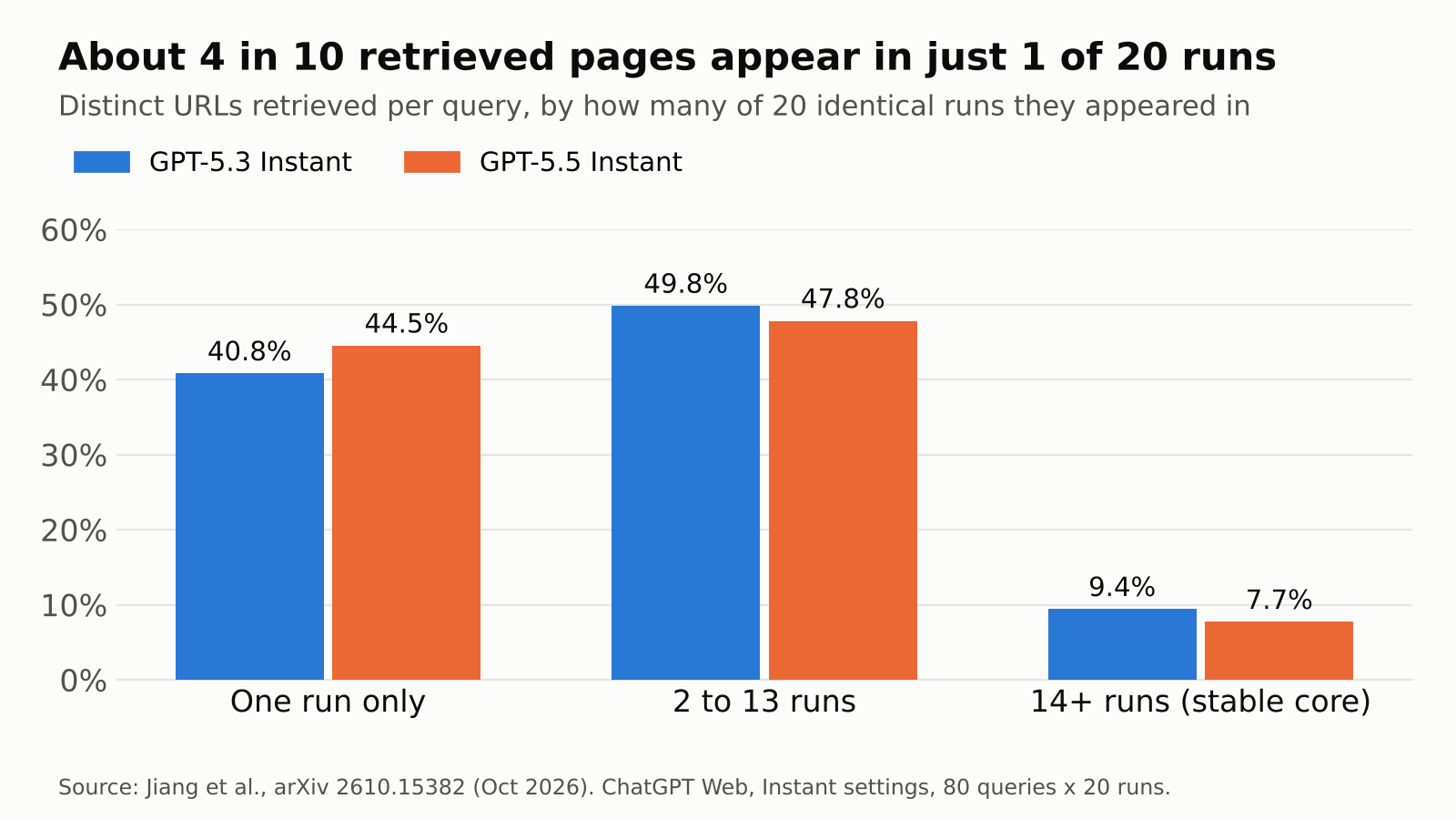
Sites were steadier than pages. ChatGPT tends to return to the same hostnames while pulling different pages from them.
ChatGPT also never searched the user’s exact wording, and for most questions asked in Chinese it searched in English only.
What gets through the second filter
The paper tested which observable features separate cited from uncited candidates within the same run.
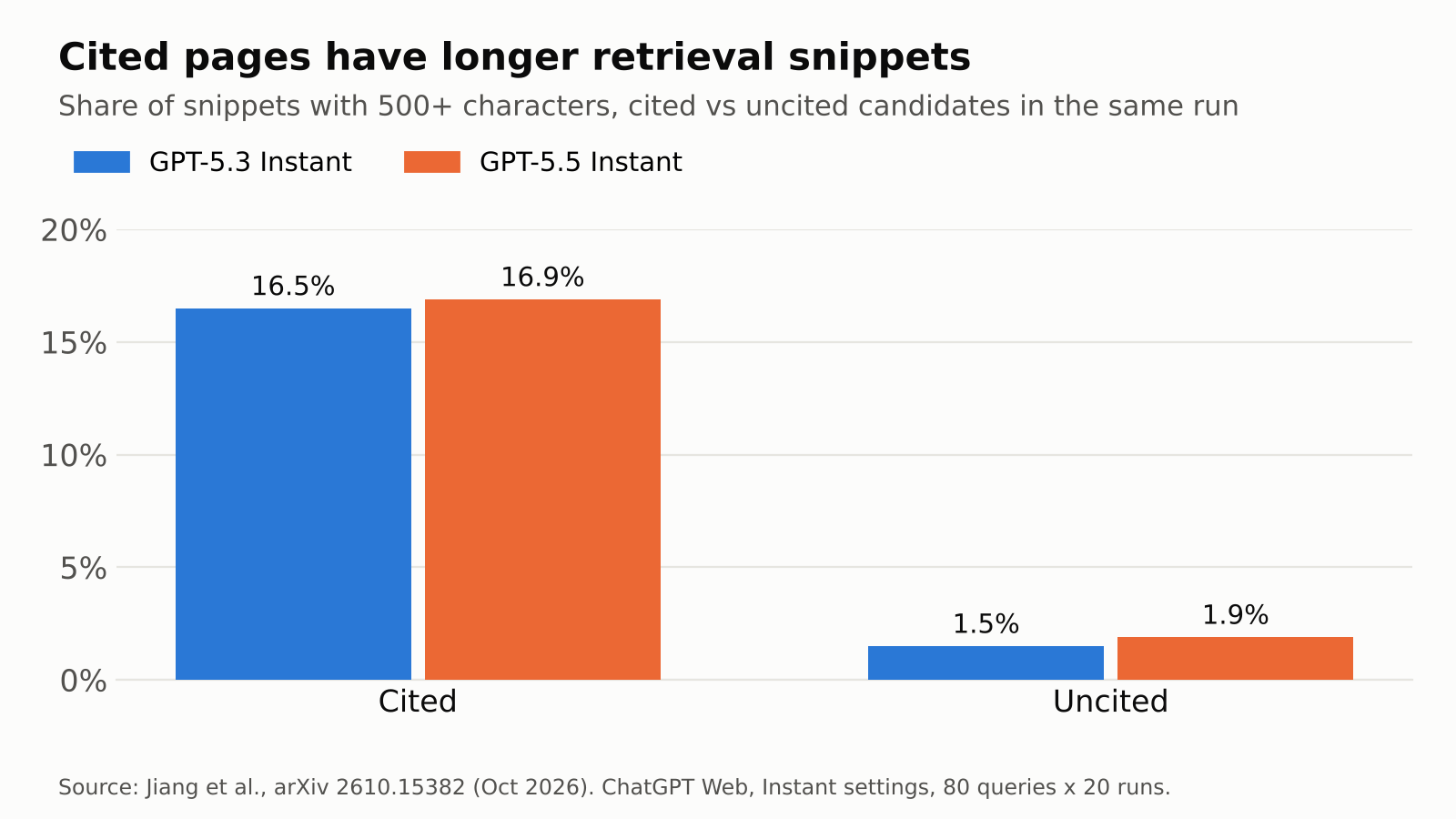
Snippet length showed the widest gap. Around 17% of cited snippets ran past 500 characters, against under 2% of uncited ones. As a single predictor it scored an AUC of 0.61 to 0.63, where 0.5 is a coin flip.
Repetition scored about the same at page level. A page that showed up in more of the other 19 runs was more likely to be cited in the held-out run, with an AUC of 0.62 to 0.65. At hostname level it rose to 0.67 to 0.71. You can only see this signal by running the same prompt many times.
Retrieval position scored an AUC of 0.56 on GPT-5.3 and 0.62 on GPT-5.5. Pages ranked below 15th were still cited 24% and 19% of the time.
Publication date showed no reliable signal. Its AUC sat between 0.48 and 0.54, with confidence intervals that include 0.5.
These are associations. Snippet length could reflect page type, structure or where the page sat in retrieval. “Write longer pages” is a conclusion this data does not support. The authors’ own hypothesis is that longer snippets give the model self-contained evidence to build an answer from.
What this means for measurement
The paper tested Google results and the OpenAI Responses API as stand-ins for ChatGPT. Combined, they found 26% to 28% of the pages ChatGPT cited. At hostname level they found about half. Google alone found 6% to 9% of cited pages.
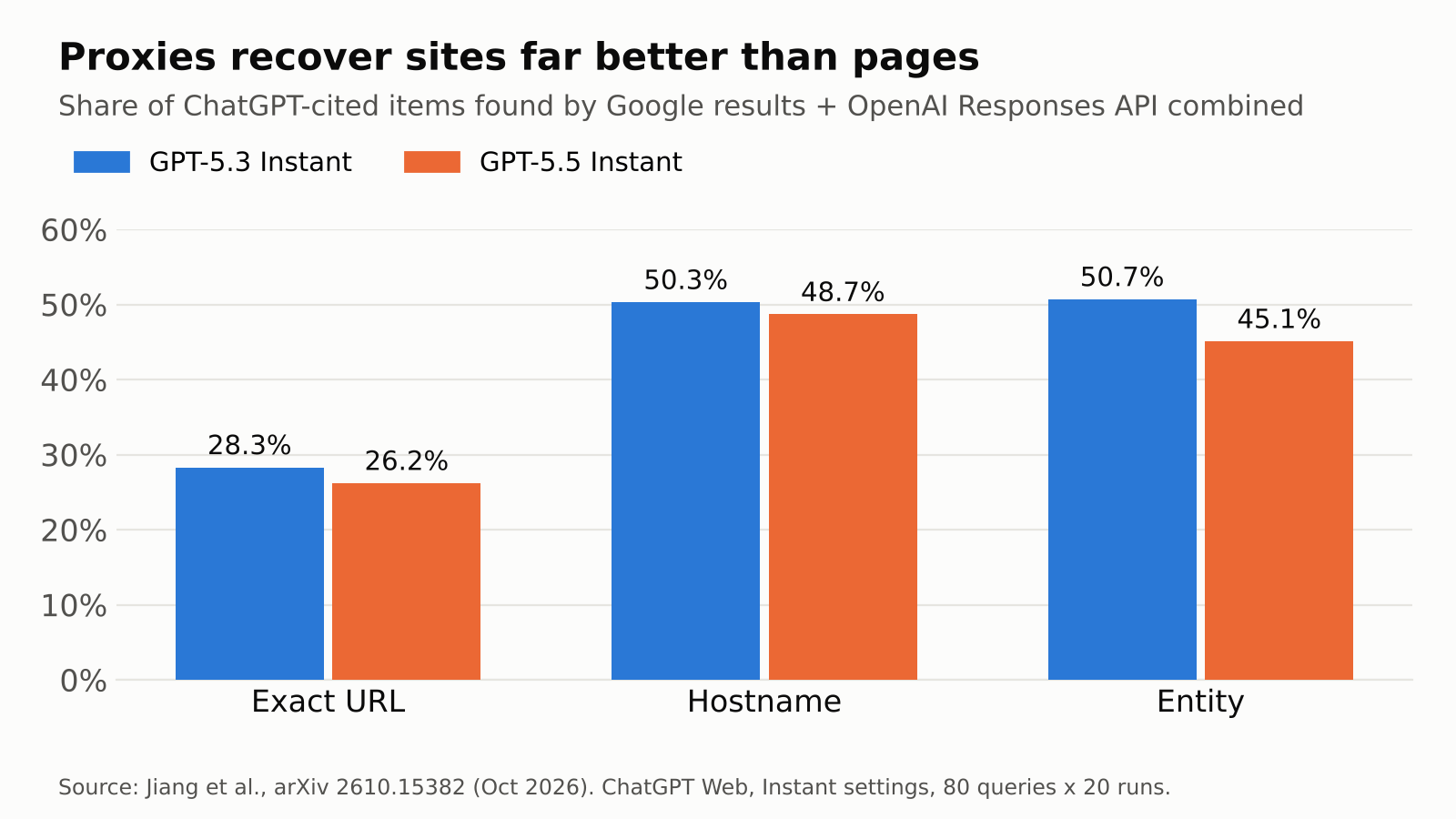
The researchers also trained a model on those outside signals. It separated cited from uncited sources well, with an AUC around 0.78 at page level. But it only ranks pages the proxies found first, so roughly three quarters of cited pages never enter it.
The paper did not test any commercial tracking tool. So before trusting a page-level AI visibility report, I’d ask three questions. Does the tool collect from the ChatGPT app or from the API? How many runs does it average per prompt? Does it record which model answered? The last one matters more than it sounds. Two of the researchers’ collection sessions silently switched to a fallback model after 14 and 16 runs.
The setup I’d trust looks like this: repeated runs per prompt, reporting at site and entity level with page level as a secondary view, retrieved and cited tracked as separate numbers, and the model logged on every response.
The models have already moved on
According to SEJ, GPT-6 is rolling out to paid ChatGPT users and GPT-5.6 Luna is becoming the default for free users. Even between GPT-5.3 and GPT-5.5, what predicted citation shifted. In the researchers’ prediction model, the weight of Google and API rank signals fell from about 50% to 35% at page level.
The study has limits worth keeping in mind. The 80 questions are general user questions, half in Chinese, rather than a brand or commercial query set. The paper counts supporting pages attached to a citation as cited, even when users never see them listed. All findings are observational.
When GPT-6 becomes the default, the useful question for a brand is which filter it now fails: retrieval, citation or the recommendation itself. For Greek brands there’s a fourth question the paper didn’t test. If ChatGPT treats Greek questions the way it treated Chinese ones, the competition for those citations is happening in English.
Till next time 👋
Ilias