Category: AI search

  • What do clients pay for once AI does the work?

    When I asked consultants what clients pay them for now that AI does much of the work, about half said judgment. I’d put it a little differently. In my experience, clients pay for results, and judgment is how you get them. When they can see those results, I can raise the retainer.

    I’ve spent 13 years building SEO in-house at global tech companies like ESET, MarineTraffic and Kpler, and now for clients. What clients buy is that experience applied to their business. They are business owners and they take risks all the time. Hiring someone who understands search well takes one of those risks off the table. A lot of the work is detail they find unglamorous and expensive, and that detail is usually what moves performance.

    How I price it

    I try to choose clients the way they choose me. Where I can, I avoid companies that don’t yet know what they want from SEO. The clients I work best with judge me on year-over-year growth in organic traffic and revenue. That is easiest with online shops, where most of the revenue can be attributed. B2B SaaS, where I specialize, has notoriously messy funnels, but the principle holds when a company knows its funnel ratios, such as how many leads become paying customers. Attribution is never perfect, but it is usually good enough for both sides to agree on.

    When growth is the measure, hours rarely come up. I don’t sell guarantees or pay-on-results deals. The client pays the retainer either way, and the results decide whether it goes up. I build each retainer around what that client needs to grow, so finishing a task faster doesn’t cost me anything. I think that matters more now than it used to. AI makes a lot of work faster, and a consultant paid by the hour earns less for using it well.

    Price rises follow from the same numbers. I show existing clients what we did and what it returned year over year. Last year I raised the retainer for every retail client whose organic revenue grew by more than 100%.

    What other consultants said

    I got 114 usable answers from consultants and agencies, sorted by theme with AI help.

    58 said clients pay for judgment. Most of the rest named something close to it, such as accountability or someone checking the work.

    The pricing answers tell a different story. 43 didn’t mention pricing at all, even though I asked directly. Only 4 said they had raised their price, while 9 had cut it or passed their savings on to clients. Most of the rest moved to fixed packages, results-based pricing (guarantees or paying only on results) or a free audit.

    I call this the judgment gap: the distance between what consultants say clients pay for and what their prices show.
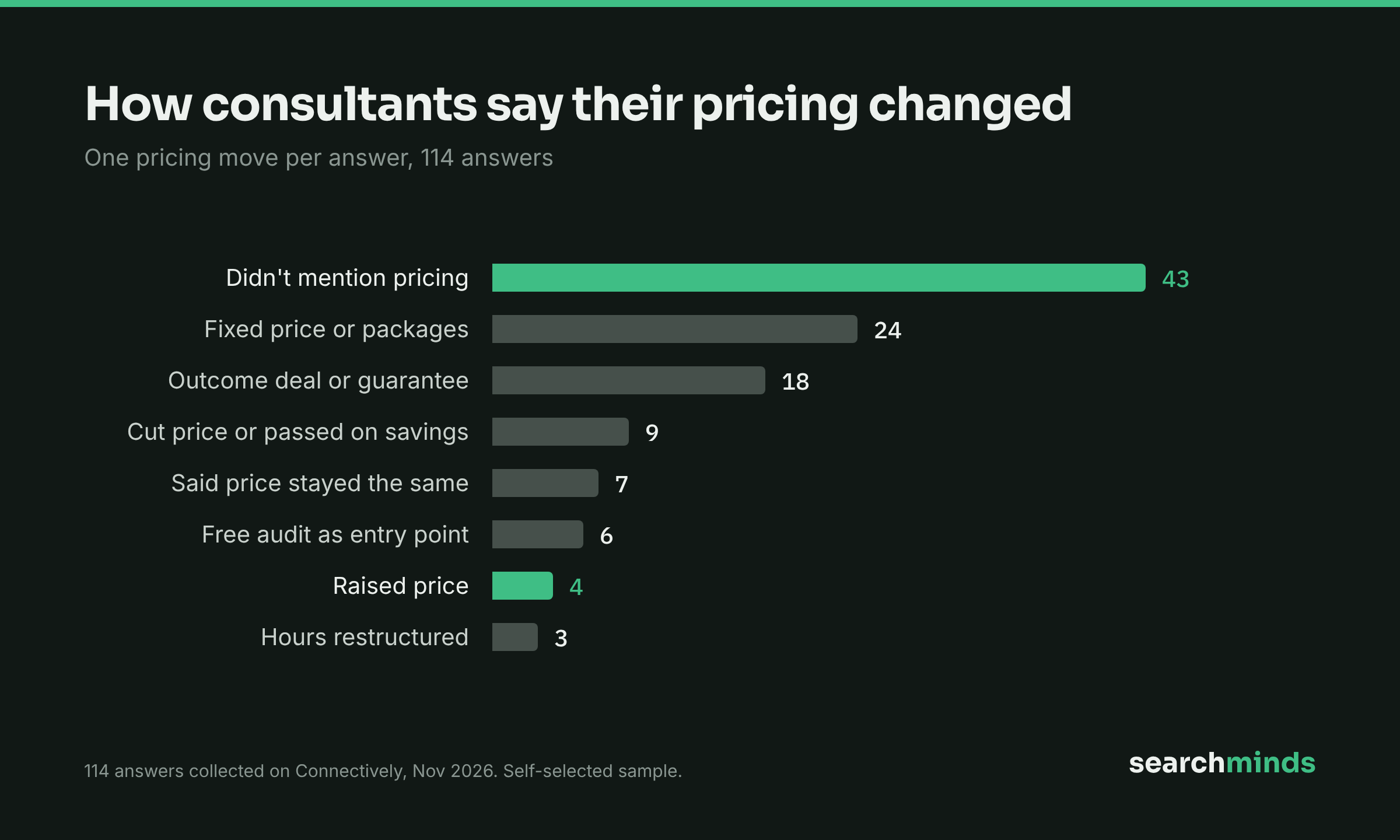
    Bar chart: 43 consultants didn't mention pricing, 24 moved to fixed packages, 18 to outcome deals, 9 cut prices, 7 kept prices the same, 4 raised them.

    Why the gap exists

    Part of it may be that flat prices hide the change. Chris Raulf of Boulder SEO Marketing said research and first drafts that took about 4 hours now take 30 to 45 minutes. He sells monthly retainers and hasn’t changed what he charges. What he changed is what he reports: 3-month sprints, measured on outcomes.

    That holds as long as clients measure outcomes. When they look at effort instead, the question tends to come up. Ihor Lavrenenko of Smarfle said his clients already ask why a task that took hours last year still costs the same. A consultant who has been reporting growth is in a better position to answer it.

    If clients pay for results, why do so few consultants say so?

    Only 6 said clients pay for results, even though 18 had moved to results-based pricing. The data doesn’t say why, so this part is my view. I think it is because results are hard to prove.
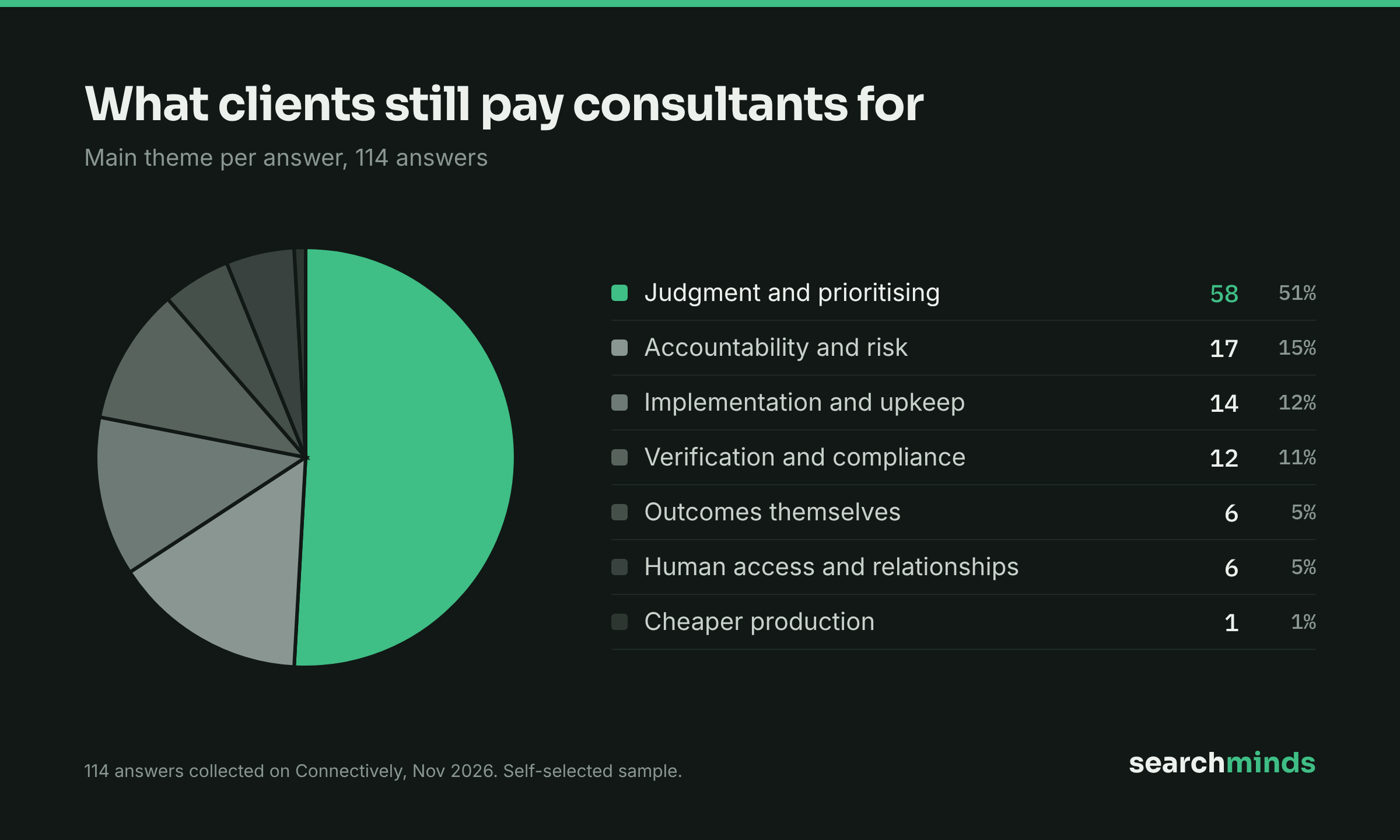
    Pie chart: 51% of consultants said clients pay for judgment, while only 6 named outcomes.

    The web is messy. Search Console data doesn’t sit inside GA4 by default. Tag Manager needs proper setup before anything is tracked well. A lot of traffic arrives with no clear source. In larger companies, several teams touch the same result, and a sale can follow a long pipeline with many touch points along the way. Much of the value SEO creates can’t be traced to a single action.

    That is why I look at results over a year. Month to month, attribution is noisy. Over 12 months, the trend in organic revenue is usually clear enough for both sides to trust.

    Getting to those yearly results takes judgment along the way. For a typical client, it means dozens of calls that each look small: which pages compete with each other and which one should rank, which default settings are holding the site back, what to fix first. Everything has to be meticulous, from the name servers to the meta descriptions. This is the unglamorous part of the work, and much of it is judgment as well as execution. Results are what the client sees. Judgment is how they get there.

    Does it still make sense to charge by the hour?

    Sometimes. Only 3 said they had restructured how they bill hours. For ongoing work tied to growth, I think hours are the wrong unit, because AI keeps shrinking them. For a one-off call or a short piece of advice, there is often no result to measure, and an hourly rate is the fairest way to price it. I still offer consulting by the hour for that reason.

    A day rate can still go up. Lilach Bullock, an AI implementation consultant and fractional CMO, raised hers from $450 to $850 in January 2025 and lost 2 of her 19 clients. She didn’t say AI caused the raise, but most of her clients stayed.

    What has worked for me

    Clients who measure hours tend to compare you with what AI costs, and that comparison rarely goes your way. That is why I work with clients who measure growth.

    Matthew Barrington-Packer of VOLTS sent a test worth running on any proposal: “if the client could get it from a chatbot in an afternoon, it shouldn’t be on the invoice.”

    If you’ve raised a price on the back of results, reply and tell me how you made the case.

    The figures come from answers to a request I posted on Connectively.
  • 5 predictions for search and AI in 2027

    5 predictions for search and AI in 2027

    This year I wrote about clicks, citations, Google’s earnings and what clients now pay for. Looking across those posts, one pattern runs through all of them: value is moving from the click to the answer. In this post, I argue that 2027 is the year the money, the metrics and the rules start to follow it, and I make five predictions to show how.

    Each prediction comes with what I’m seeing now and the result that would prove me wrong. Most rest on public evidence, and where a call comes from my own client work, I say so.

    1. AI completes half of real freelance projects

    In February I wrote that AI fails at about 97% of real remote jobs. The Remote Labor Index, built from 240 paid freelance projects, scored the best agent at 2.5%. Each project runs end to end: a real brief, the input files, and a deliverable judged on whether a reasonable client would accept it.

    The scores have moved fast. By late October 2026, Opus 5.5 led at about 21%, with GPT 6 Astra close behind. That’s roughly eight times the original best in a year.

    So how does 21% become 50%? At this pace, the top score reaches the low 40s by December 2027. Reaching 50% needs the pace to pick up. METR’s research points the same way: the length of task agents can finish has been doubling every four to seven months.

    The limits matter. These are digital projects with no client conversations, and the benchmark leaves out work judged over time, like SEO. Half also means half still fail. But once agents can deliver half of paid projects, the deliverable stops being the hard part. What clients pay for moves to judgment.

    I’m wrong if: the top Remote Labor Index score is still below 50% in December 2027.

    2. AI traffic stays under 1%, however big the hype gets

    AI answers increasingly shape which brands people hear about. They still send very few visits. SE Ranking measured AI platforms at 0.32% of all website traffic in early 2026, across about 101,000 sites. To pass 1% by the end of 2027, that share would need to roughly triple. I don’t expect it to.

    Why so few visits? The gap is built into the product. A Bocconi University study of US desktop browsing found ChatGPT sessions lead to a click out 5.2% of the time, against 31.1% for Google searches. In other words, Google sends a visit for about one search in three, and ChatGPT for about one session in twenty. AI answers are designed to finish the job on the page. Usage can keep growing while clicks to websites barely move.

    The open web is losing out on Google too. In the third quarter of 2026, Google Network, the ads Google places on other companies’ sites and apps, brought in $7.46 billion out of $82 billion in Google advertising. That’s about 9%, down from almost 10% a year earlier. Network grew mainly because of AdMob, Google’s app ads. AdSense, the ads on websites, shrank, and Network impressions fell 14% year on year. Not all of that is AI. Google’s ad business keeps growing, while the share that runs on other people’s sites shrinks.

    My client work matches. The pages that earn AI citations are mostly informational. Product and category pages bring the revenue, and most of it still arrives through Google. AI visitors convert well, but there are few of them.

    Few visits haven’t held budgets back. Conductor’s 2026 CMO report says enterprises put about 12% of their digital budgets into AI search in 2025, and 94% planned to spend more in 2026. Conductor sells AI search tools and ran the survey, so read the number as a direction. The same leaders named measuring ROI one of their two biggest AI search challenges.

    So brand leaders have two jobs. Win the mention in AI answers, because that’s where shortlists form. Keep investing in Google, because that’s where visits and sales still arrive. Then measure AI on mentions, share of answers and assisted revenue, because last-click attribution misses much of its influence.

    I’m wrong if: by the end of 2027, SE Ranking’s latest study, or a comparable one across 100,000 or more sites, shows AI sending 1% or more of all visits.

    3. The EU fines no AI model provider in 2027

    Brussels now has the powers. The EU AI Office gained enforcement powers over general-purpose AI providers in August 2026. On 1 September, the Commission confirmed it had sent its first formal information requests to more than 30 AI companies. Fines on these providers can reach 3% of global turnover. The Commission also designated ChatGPT a very large online search engine under the Digital Services Act, which brings its own obligations.

    Why expect no fines, then? Using the powers is another matter. The first big AI Act case will set the rules for everyone, and losing it would cost Brussels far more than settling. Italy showed how easily a first case can fail: its €15 million GDPR fine against OpenAI was annulled in March on jurisdictional grounds. Brussels wants to show the AI Act has teeth, but a fine overturned on appeal would show the opposite. Commitments and negotiated fixes are the safer path, and that’s the path I expect.

    For brands and users in Europe, that means gradual change. More disclosures, more labels, more documentation. Sudden product pullouts are unlikely. The real cost is speed: some AI features will reach Europe months after the US.

    I’m wrong if: the European Commission fines any general-purpose AI provider under the AI Act in 2027.

    4. Publishers settle instead of winning in court

    Antitrust hasn’t helped publishers. On 30 September 2026, Judge Mehta dismissed the antitrust suits Penske Media and Chegg brought against Google over AI Overviews.

    Copyright gives publishers some leverage, mostly over how AI companies obtained the content. In September 2026, a federal appeals court upheld Thomson Reuters’ win against Ross Intelligence, the first appeals ruling to reject fair use for training AI on publisher content, though in a tool that did not generate text.

    Doesn’t a publisher win cut against my headline? Look at the other big case. In July, a judge approved Anthropic’s $1.5 billion settlement with authors. Judge Alsup had earlier ruled that training Claude on their books was fair use, but keeping more than 7 million pirated copies was not. Neither ruling is the final word on generative AI, and that uncertainty is the point: paying is safer than waiting for a verdict.

    So the money moves to the table. AI companies need fresh, trusted content, and a licensing deal costs less than a trial. OpenAI has signed with News Corp, the Financial Times and Axel Springer, and Google pays Reddit for its content. The big test is The New York Times’ case against OpenAI, which is waiting on a summary judgment ruling. I expect it to settle.

    The index adds pressure. Judge Mehta’s remedies in the search monopoly case require Google to share parts of its index and search data with qualified rivals. Google is appealing, and so are the Justice Department and the states, who want harsher remedies. My read: if data-sharing survives, AI rivals can build answers that compete with Google’s, and more AI companies bid to license publisher content.

    For SEO, visibility will depend on whose index an answer is built from and which sources have a deal. Rankings alone will explain less of it.

    I’m wrong if: fewer than two publisher lawsuits against AI companies end in licensing deals in 2027, or a court rules for a publisher against a generative AI company.

    5. One-number AI visibility scores stop being trusted

    AI answers change from run to run. In October I covered a study tracing ChatGPT from search to citation. It retrieves far more pages than it cites, and what it retrieves shifts between identical runs. One prompt, run once, tells you very little.

    Most visibility reports still show a single number. A September review of 14 AI visibility tools found that none publish how much a score moves between identical runs. That works while the category is new. It stops working the first time finance asks why the score dropped ten points when nothing changed.

    You can test this yourself today. Pick one buying question in your category. Ask ChatGPT the same question ten times in fresh chats, and write down which brands appear each time. Then compare that spread with the single number your tool reports.

    Expect clients to ask for ranges, sample sizes and confidence levels. Tools that show the spread will win the serious buyers. One screenshot of an AI answer will stop being proof of anything.

    I’m wrong if: by December 2027, none of Semrush, Ahrefs, SE Ranking or Profound shows a range.

    What comes next

    Put the five calls side by side and they tell one story. Agents take on more of the work. AI answers keep most of the visits. Regulators negotiate, publishers get paid, and visibility scores turn into ranges. Underneath each one, value keeps moving from the click to the answer.

    In December I’ll publish a second piece with predictions from people across search and AI, so you can set their calls against mine.

    I won’t get all five right. That’s why each one ends with what would prove me wrong. I’d rather be scored than vague.