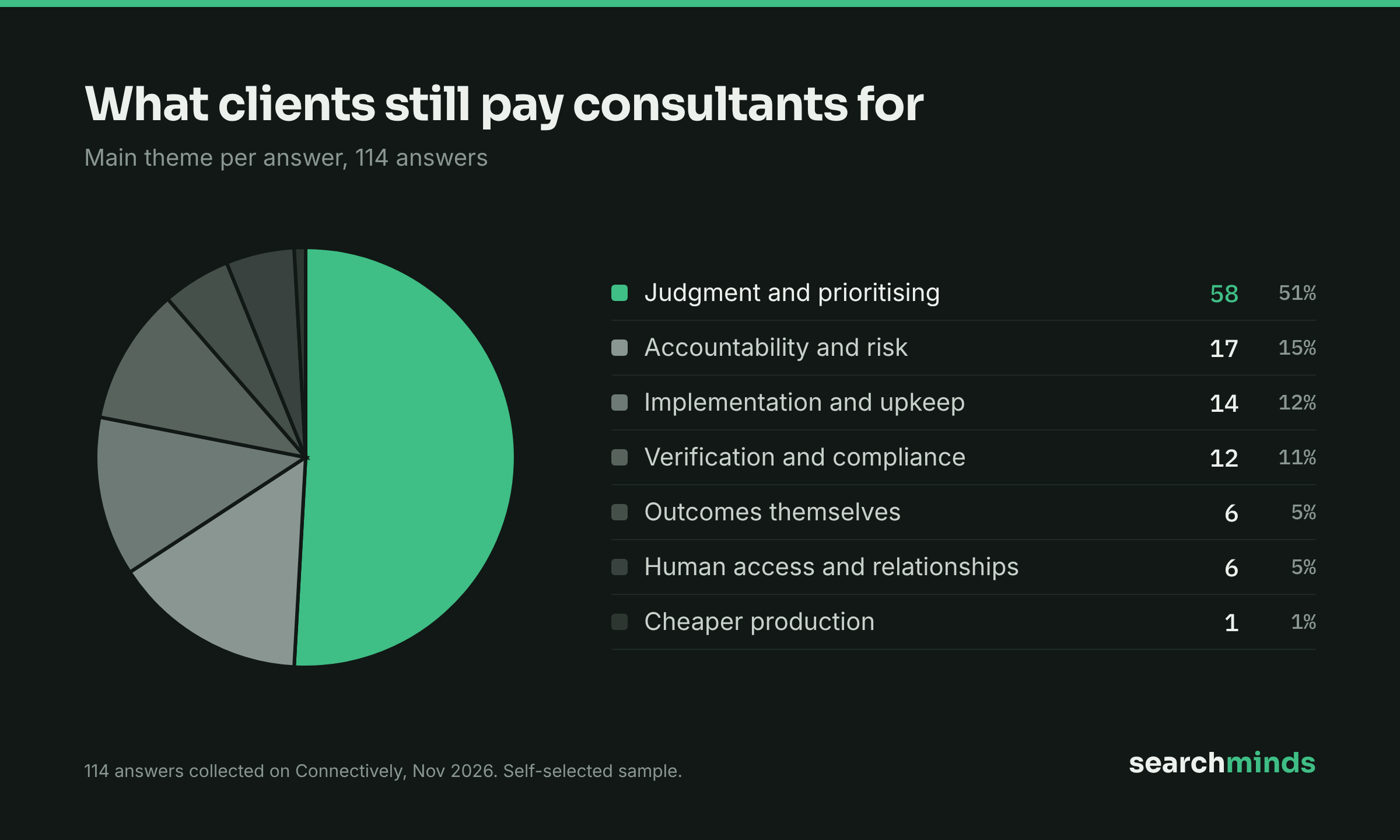
When I asked consultants what clients pay them for now that AI does much of the work, about half said judgment. I’d put it a little differently. In my experience, clients pay for results, and judgment is how you get them. When they can see those results, I can raise the retainer.
I’ve spent 13 years building SEO in-house at global tech companies like ESET, MarineTraffic and Kpler, and now for clients. What clients buy is that experience applied to their business. They are business owners and they take risks all the time. Hiring someone who understands search well takes one of those risks off the table. A lot of the work is detail they find unglamorous and expensive, and that detail is usually what moves performance.
How I price it
I try to choose clients the way they choose me. Where I can, I avoid companies that don’t yet know what they want from SEO. The clients I work best with judge me on year-over-year growth in organic traffic and revenue. That is easiest with online shops, where most of the revenue can be attributed. B2B SaaS, where I specialize, has notoriously messy funnels, but the principle holds when a company knows its funnel ratios, such as how many leads become paying customers. Attribution is never perfect, but it is usually good enough for both sides to agree on.
When growth is the measure, hours rarely come up. I don’t sell guarantees or pay-on-results deals. The client pays the retainer either way, and the results decide whether it goes up. I build each retainer around what that client needs to grow, so finishing a task faster doesn’t cost me anything. I think that matters more now than it used to. AI makes a lot of work faster, and a consultant paid by the hour earns less for using it well.
Price rises follow from the same numbers. I show existing clients what we did and what it returned year over year. Last year I raised the retainer for every retail client whose organic revenue grew by more than 100%.
What other consultants said
I got 114 usable answers from consultants and agencies, sorted by theme with AI help.
58 said clients pay for judgment. Most of the rest named something close to it, such as accountability or someone checking the work.
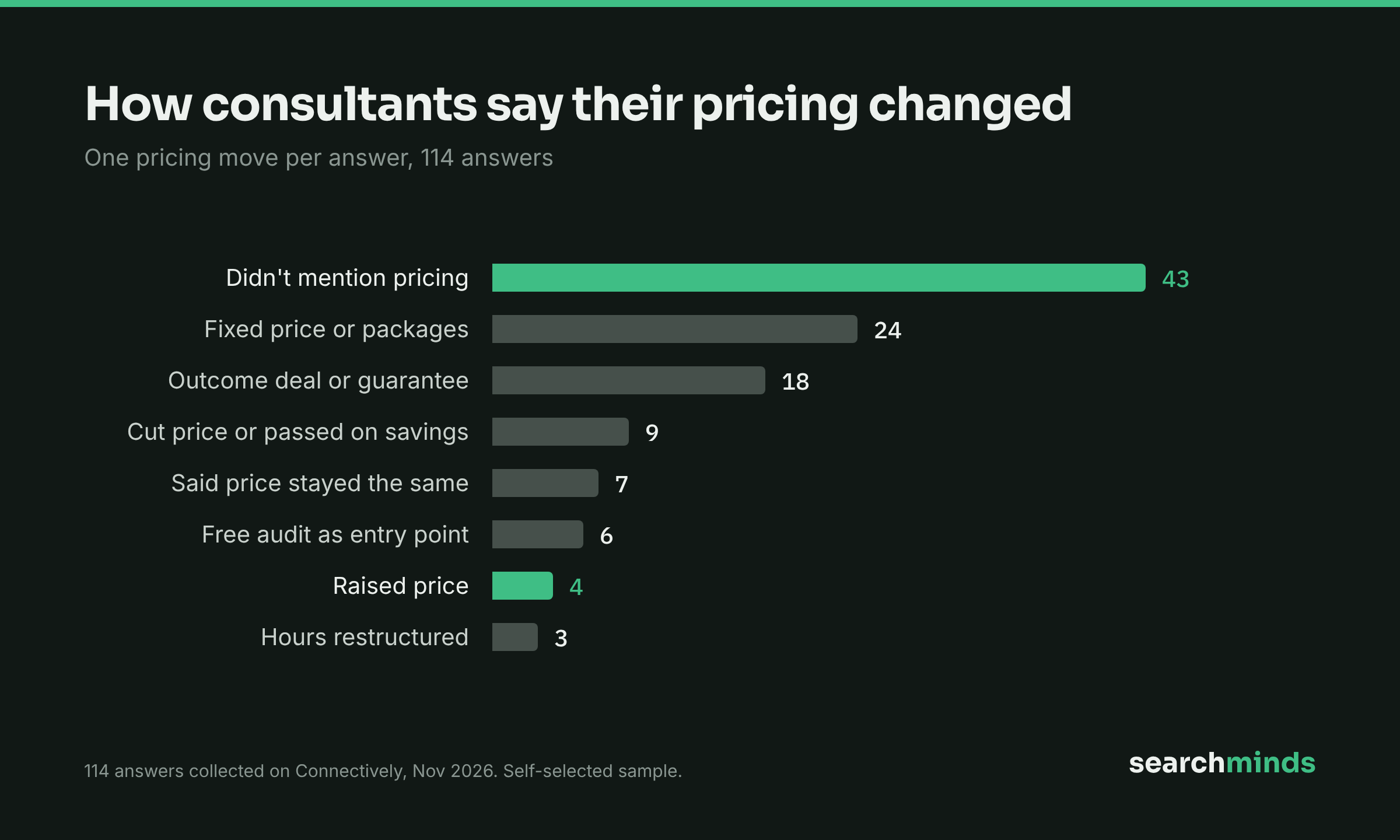
The pricing answers tell a different story. 43 didn’t mention pricing at all, even though I asked directly. Only 4 said they had raised their price, while 9 had cut it or passed their savings on to clients. Most of the rest moved to fixed packages, results-based pricing (guarantees or paying only on results) or a free audit.
I call this the judgment gap: the distance between what consultants say clients pay for and what their prices show.
Why the gap exists
Part of it may be that flat prices hide the change. Chris Raulf of Boulder SEO Marketing said research and first drafts that took about 4 hours now take 30 to 45 minutes. He sells monthly retainers and hasn’t changed what he charges. What he changed is what he reports: 3-month sprints, measured on outcomes.
That holds as long as clients measure outcomes. When they look at effort instead, the question tends to come up. Ihor Lavrenenko of Smarfle said his clients already ask why a task that took hours last year still costs the same. A consultant who has been reporting growth is in a better position to answer it.
If clients pay for results, why do so few consultants say so?
Only 6 said clients pay for results, even though 18 had moved to results-based pricing. The data doesn’t say why, so this part is my view. I think it is because results are hard to prove.
The web is messy. Search Console data doesn’t sit inside GA4 by default. Tag Manager needs proper setup before anything is tracked well. A lot of traffic arrives with no clear source. In larger companies, several teams touch the same result, and a sale can follow a long pipeline with many touch points along the way. Much of the value SEO creates can’t be traced to a single action.
That is why I look at results over a year. Month to month, attribution is noisy. Over 12 months, the trend in organic revenue is usually clear enough for both sides to trust.
Getting to those yearly results takes judgment along the way. For a typical client, it means dozens of calls that each look small: which pages compete with each other and which one should rank, which default settings are holding the site back, what to fix first. Everything has to be meticulous, from the name servers to the meta descriptions. This is the unglamorous part of the work, and much of it is judgment as well as execution. Results are what the client sees. Judgment is how they get there.
Does it still make sense to charge by the hour?
Sometimes. Only 3 said they had restructured how they bill hours. For ongoing work tied to growth, I think hours are the wrong unit, because AI keeps shrinking them. For a one-off call or a short piece of advice, there is often no result to measure, and an hourly rate is the fairest way to price it. I still offer consulting by the hour for that reason.
A day rate can still go up. Lilach Bullock, an AI implementation consultant and fractional CMO, raised hers from $450 to $850 in January 2025 and lost 2 of her 19 clients. She didn’t say AI caused the raise, but most of her clients stayed.
What has worked for me
Clients who measure hours tend to compare you with what AI costs, and that comparison rarely goes your way. That is why I work with clients who measure growth.
Matthew Barrington-Packer of VOLTS sent a test worth running on any proposal: “if the client could get it from a chatbot in an afternoon, it shouldn’t be on the invoice.”
If you’ve raised a price on the back of results, reply and tell me how you made the case.
The figures come from answers to a request I posted on Connectively.