
Eurostat published new data on the use of generative AI across the European Union.
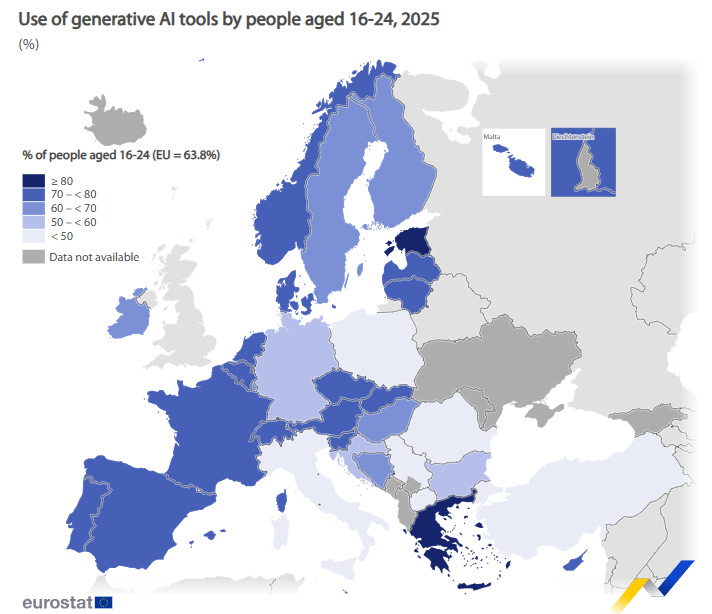
The key figure is straightforward: 63.8% of people aged 16–24 used generative AI tools in 2025.
For the total population, ages 16–74, the number is 32.7%.
This reflects how early AI becomes part of daily behavior for younger users.
What the dataset captures
Among people aged 16–24:
-
44.2% use generative AI for private purposes
-
39.3% use it for education
-
15.8% use it for work
Professional usage is broadly aligned with the total population. The divergence appears earlier, in how people learn, explore topics, write, and test ideas.
AI is already embedded before formal employment begins.
Greece as an outlier
Greece sits at the top of the distribution.
More than 80% of people aged 16–24 report using generative AI. That places it among the highest adoption rates in the EU.
This matters as a signal.
A large share of young people here already treat AI as a normal input. They reach for it without friction. The habit is formed.
Soon, these users will move into universities, companies, and public institutions with AI workflows already established, similar to how I entered a workforce shaped by an earlier internet era.
They will expect systems to accommodate that reality. Not through slogans or policy documents, but through tools that integrate naturally into how they already work.
Systems will adapt, or they will be bypassed.
The practical question
The next step is leverage.
This cohort is already more tool-savvy than their parents, their teachers, and often their managers. They move faster because they do not need onboarding into the concept of AI. They need better inputs and clearer constraints.
That creates an opportunity.
Organizations can design workflows that assume AI fluency. Education can move from policing usage to improving judgment. Companies can focus on quality, verification, and domain knowledge instead of basic adoption.
The leverage lies in giving them environments where that fluency produces better outcomes.
Greek youth is already there. The response from institutions will determine what compounds next.
Systems that do this will move faster. The rest will feel slow by comparison.
Till next time 👋
Ilias