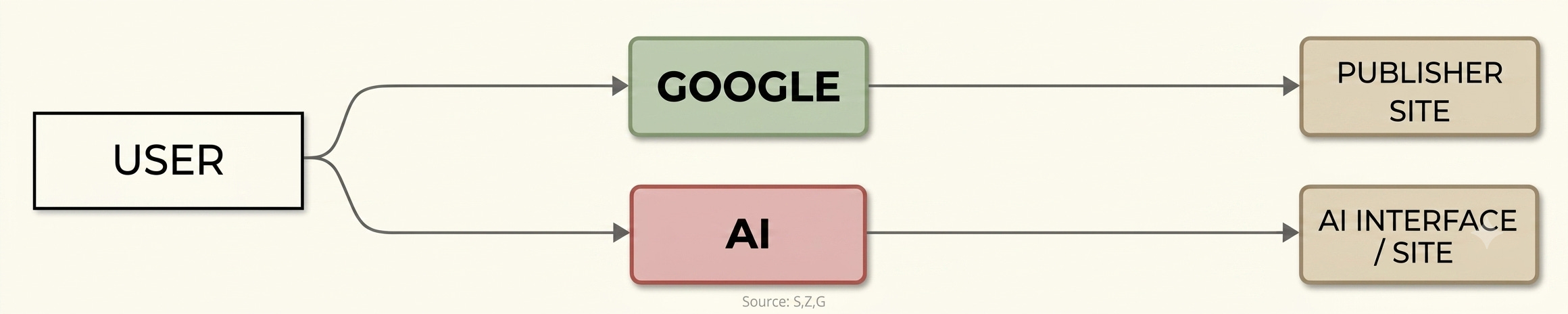
Note: This post summarizes and comments on Answering Without Referring: How AI Search Rewrites the Web’s Economic Bargain by Qiaoni Shi, Kai Zhu and Kai Gu. I did not conduct the original research. This is simply my summary and commentary.
In my previous post, I looked at how brands earn visibility inside AI answers. This paper explores the other side of the equation: what happens when visibility no longer guarantees a click?
The number that changes how you read the rest of the paper
One number from a new working paper by Bocconi University researchers caught my attention:
31.1%
That’s the share of Google searches that result in an outbound click to another website.
For ChatGPT, the equivalent number is:
5.2%
The difference is significant. It highlights how differently users move through information online.
The researchers analyzed Comscore clickstream data covering 61 million Google searches and 409,000 ChatGPT conversation sessions between October 2024 and July 2025. The headline finding:
ChatGPT produces an outbound click in 5.2% of conversation sessions. Google does so in 31.1% of searches.
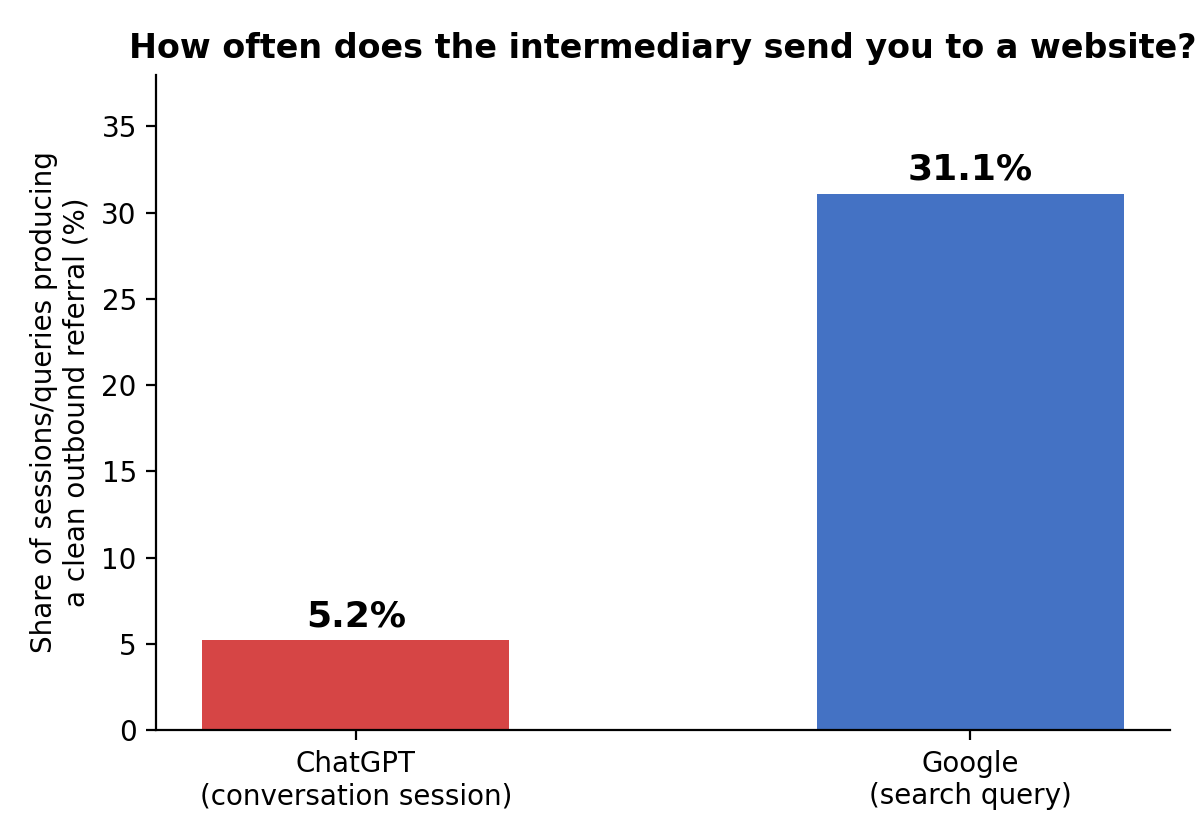
The researchers also found that around three-quarters of ChatGPT-active households recorded no outbound click from ChatGPT during the ten-month observation period.
AI search creates a different traffic economy
The clicks that do happen look different from traditional search referrals.
ChatGPT referrals are more likely to go toward reference sites, academic resources, developer documentation, and SaaS products.
Google’s referral traffic remains more concentrated around large consumer platforms such as YouTube, Reddit, and Wikipedia.
The important point for publishers is that AI search does not simply reduce traffic volume. It changes where that traffic goes.
The websites most dependent on advertising-supported informational content are exposed to a different environment: users can increasingly get answers without reaching the original source.
One nuance from the paper is worth mentioning: the greater diversity of ChatGPT referrals exists across households, not necessarily within individual users. It does not mean every niche website receives a larger share of AI traffic. It means the smaller pool of AI-driven clicks is distributed across a wider range of destinations.
The bigger question: are people replacing search with AI?
Comparing Google users and ChatGPT users directly would not be enough.
The researchers used the staggered rollout of ChatGPT Search as a natural experiment:
-
Paid users received access first in October 2024
-
Free logged-in users followed in December
-
Anonymous users followed in February 2025
This allowed them to compare search behavior before and after households gained access.
After access was introduced, traditional search activity declined by 9.4%.
After twenty weeks of sustained use, the decline reached 17%.
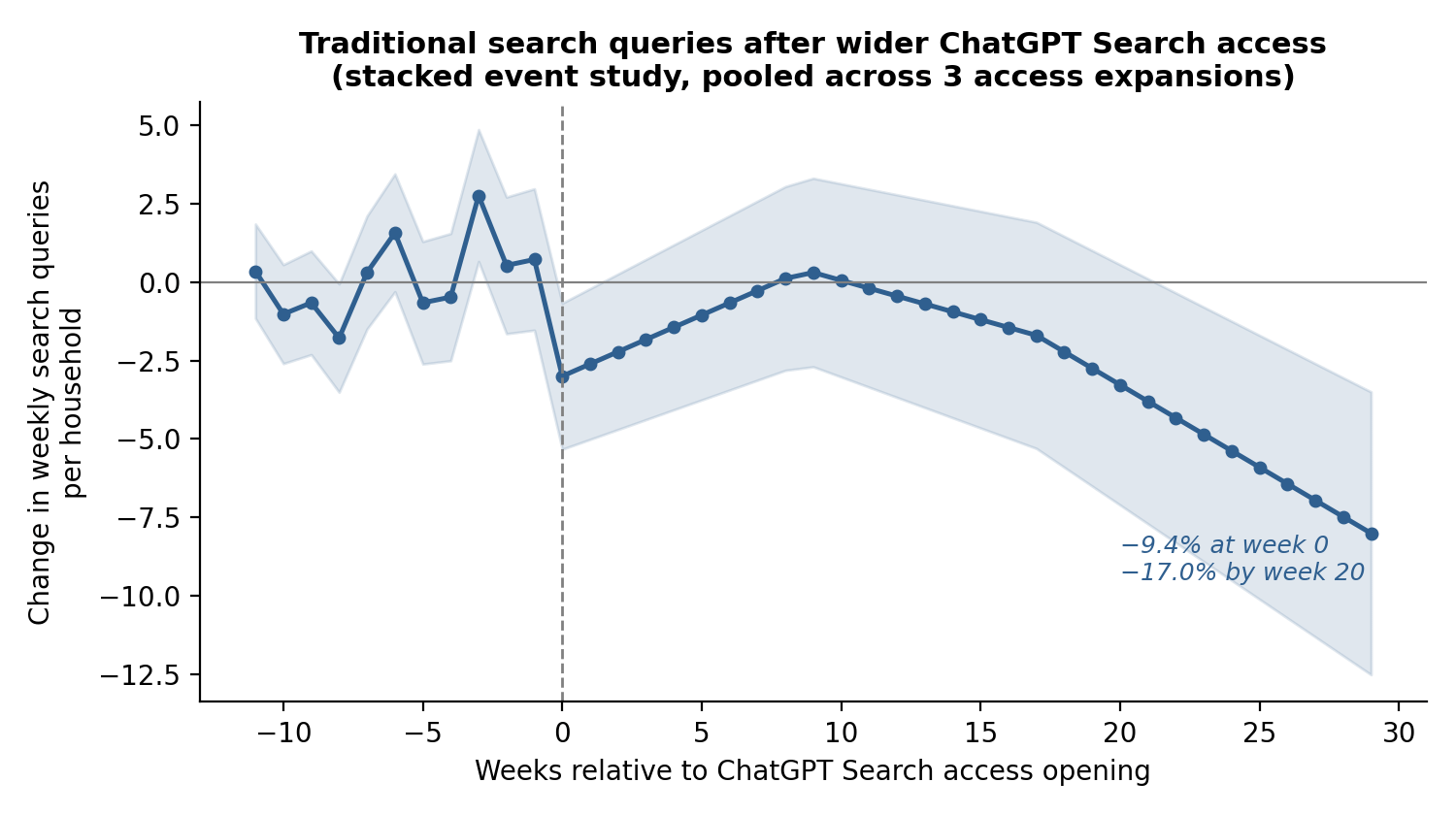
The paper does not claim that every lost Google search became a ChatGPT query. It shows that broader access to AI search reduces reliance on traditional search engines.
That distinction matters.
The impact is concentrated in informational content
The decline was not evenly distributed across categories.
The largest effects appeared in:
-
Academic research: -33%
-
Reference and knowledge sites: -27%
-
Developer and technical resources: -15%
Transactional and entertainment categories showed little measurable change.
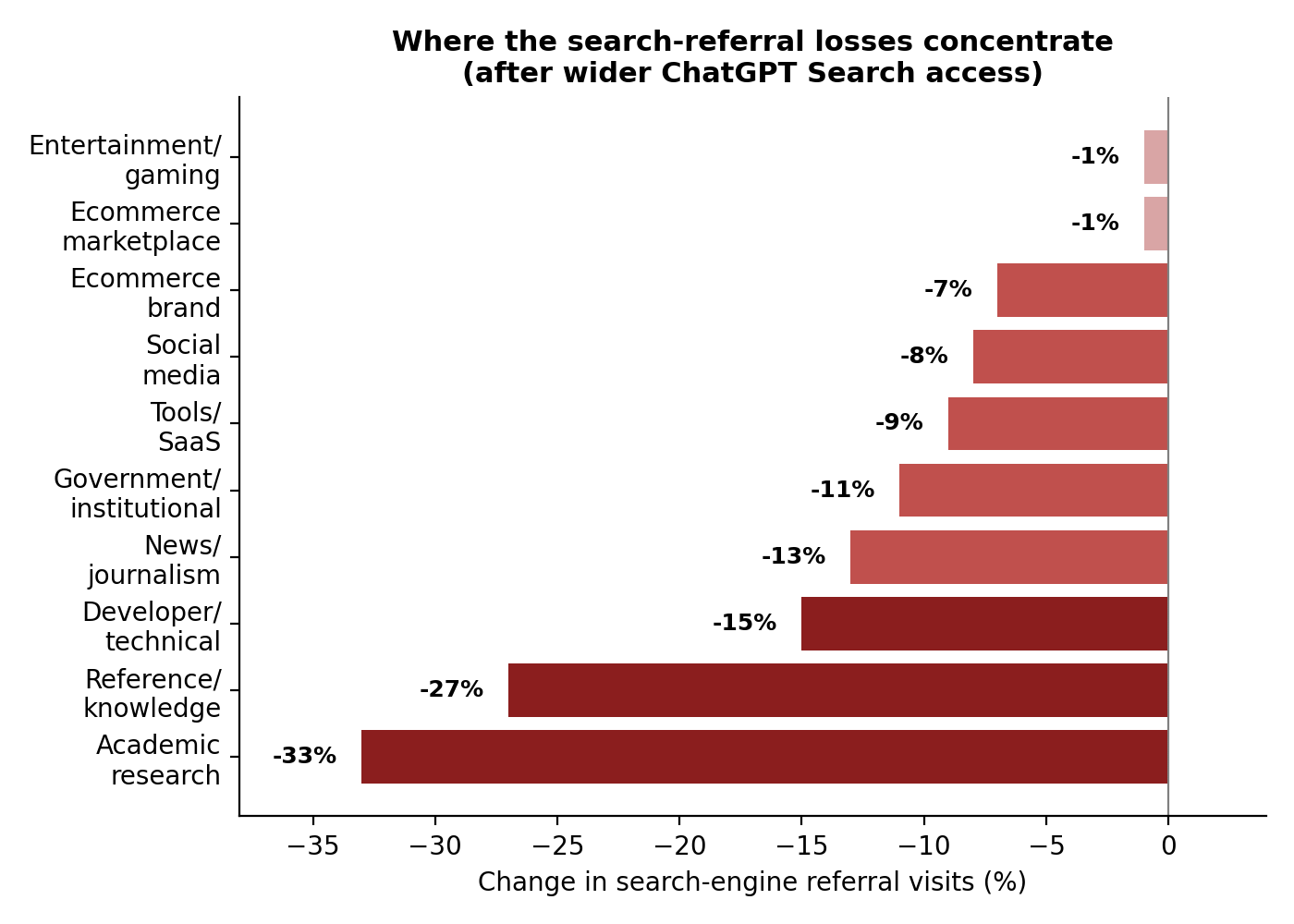
This pattern makes sense.
AI search is strongest when the user’s goal is understanding something: definitions, explanations, comparisons, summaries, and research.
Those are exactly the queries that historically sent users to informational publishers.
What this means for SEO
If you manage informational content and have seen organic traffic pressure recently, this provides a possible explanation.
The challenge is that users may never reach the search results page.
The query itself may no longer reach a search engine.
The user gets an answer inside an AI interface before clicking through to a website.
This changes the optimization problem.
For years, SEO focused on winning rankings and earning clicks.
Increasingly, visibility may depend on being included, referenced, and trusted inside the answer itself.
A few important caveats
The paper also highlights an important distinction around AI crawlers.
Blocking AI crawlers through robots.txt does not necessarily prevent AI search traffic changes. Crawling, model training, and runtime retrieval are separate mechanisms.
A website can block a crawler and still appear in AI-generated answers through other data sources or retrieval systems.
The bigger question
The paper does not answer whether the web becomes better or worse as AI search grows.
It measures how traffic patterns change.
The unanswered question is economic:
What happens to high-quality reference content when producing it becomes more expensive, while the traditional traffic reward becomes smaller?
The web has always depended on a simple exchange:
-
People create information.
-
Search engines send visitors.
-
Visitors create value.
AI search changes that exchange, among other things.
For SEO teams, the challenge ahead is understanding how to create value when discovery increasingly happens without the click.
Till next time 👋
Ilias