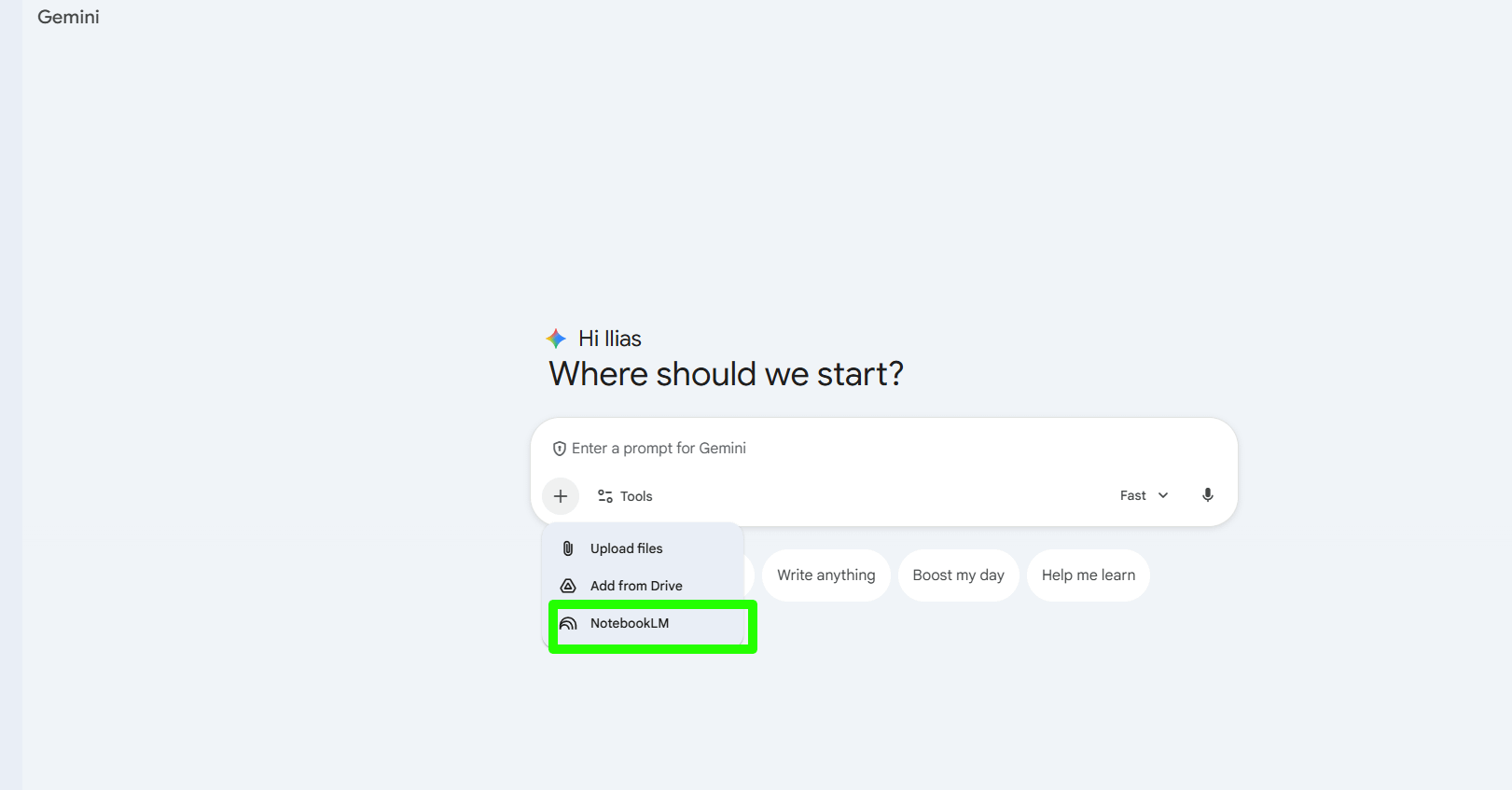
In January, Google added the ability to attach NotebookLM notebooks as a source inside Gemini. Once attached, Gemini can use the material in those notebooks for reasoning, writing, and synthesis.
If you already use NotebookLM seriously, this closes a gap that has been obvious for a while.
What the feature actually does
Inside Gemini, you can attach a NotebookLM notebook from the same menu used to add files or Drive documents. Once attached, the notebook becomes part of the conversation context.
Gemini can then:
-
Reference PDFs, Docs, slides, transcripts, and notes stored in that notebook
-
Answer questions grounded in that material
-
Generate drafts and summaries tied to specific sources
NotebookLM already organizes and synthesizes large document sets. Gemini builds on top of that by handling reasoning, iteration, and content creation.
The result is a single, continuous workflow.
Why this matters in practice
Most AI workflows start to fail once context becomes large or specific.
People copy chunks of text, re-explain background, or simplify questions because feeding full context into LLMs is tedious. Accuracy drops as soon as the model drifts away from the source material.
With notebooks attached directly, context stays persistent. You build it once and reuse it across multiple Gemini conversations. The effort shifts from repeating prompts to asking better questions.
This is especially relevant for:
-
research-heavy projects
-
internal documents
-
long-running initiatives where context accumulates
-
outputs that need to stay aligned with evidence
A more useful mental model
NotebookLM functions as a long-term knowledge base.
Gemini functions as the interface on top of that knowledge.
You gather and structure material in NotebookLM. Gemini works with it to produce drafts, analysis, summaries, and strategic output. Each tool serves a distinct role within the same workflow.
Where this compounds over time
Each notebook increases the value of Gemini.
As notebooks grow, answer quality improves without extra prompt engineering. The AI benefits from accumulated context instead of starting fresh every time.
This makes sense for:
-
long-form writing that requires consistency
-
strategy work tied to internal research
-
SEO and analysis where grounding matters
-
workflows where hallucinations are costly
What this unlocks at scale
This integration is less about convenience and more about capacity.
Gemini can ground its responses in NotebookLM notebooks attached directly to a chat. When a notebook is attached, Gemini answers based on the documents inside it and can cite those sources. Output stays tied to real material.
You can attach multiple notebooks to a single Gemini thread, allowing one conversation to operate across several bodies of knowledge at the same time. Research, internal docs, specs, transcripts, and historical material can all sit in the same working context.
Each notebook supports up to 300 sources. That materially raises the ceiling. Queries can now be grounded in hundreds of assets across multiple notebooks inside a persistent chat.
Gemini can take insights derived from those sources and use them to produce new output: drafts, analysis, plans, structured content, and strategic reasoning built on top of the underlying material.
Because the Gemini interface preserves chat history, context compounds over time. You can iterate, refine, and build progressively while staying anchored to the same source set.
The real work now is organizing the source material and scalability, not stretching prompts to fit more context.
Till next time 👋
Ilias