Clatification: The data, methodology, framework names (Universal 36, Source Surplus, Concentration Curve), and case studies mentioned below come from Semrush and Adobe. I did not conduct the original research. This is simply my summary and commentary on the report.
The core distinction: mentions ≠ citations
The report separates two metrics that many teams still treat as the same thing.
A mention is when AI names your brand in an answer.
A citation is when AI uses your website as a source.
They are earned through different mechanisms.
Mentions usually reflect:
-
Brand authority
-
Category relevance
-
Market presence
Citations usually reflect:
-
Content depth
-
Source quality
-
Third-party authority
The two do not move together.
Wikipedia is cited constantly, but rarely the subject of an answer. Patagonia gets mentioned heavily but receives fewer citations.
Across the four platforms analyzed, the overlap between brands mentioned and brands cited ranges from 30% on Gemini to 64% on AI Overviews.
Tracking only one metric means you’re missing part of the picture.
AI platforms behave very differently
This is probably the biggest takeaway from the report.
A single “AI Visibility” score hides important differences between platforms.
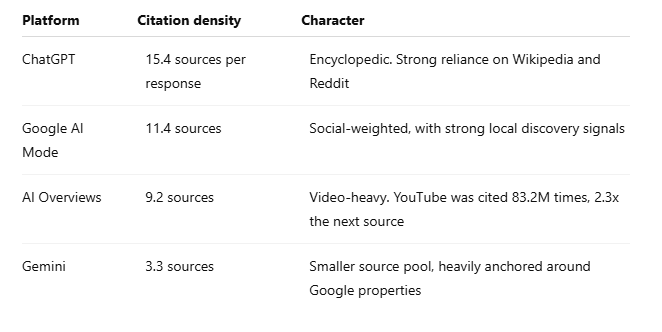
The overlap between ChatGPT and AI Overviews mentions is only around 50–56%.
The implication is simple: optimizing for one AI platform and assuming the same strategy works everywhere is unlikely to produce results
The “Universal 36”
Only 36 brands appeared in every platform’s top 100 every month between January and April.
The list includes brands like YouTube, Reddit, Amazon, Apple, Disney, and LEGO.
The common pattern is clear: platform-scale audiences, category leadership, or decades of accumulated authority.
No news publishers made the list.
For most companies, this group is not the benchmark. Your category matters more than the global leaderboard.
Category concentration changes the opportunity
The report’s “Concentration Curve” measures how much of a category’s top 10 mentions are controlled by the top three brands.
The most concentrated categories:
-
News & Media: 82.9%
-
Consumer Electronics: 76.9% (Apple alone is 5x Samsung)
The least concentrated:
-
Finance: 41.4%
-
Industrial: 42.2%
The practical takeaway:
In flatter categories, gaining visibility share is more realistic.
In highly concentrated categories, moving from positions 8–10 into the top five may be a better target than trying to replace the category leader.
The “Source Surplus” concept
One of the more interesting ideas in the report is Source Surplus.
Some websites are cited far more often than they are mentioned as the actual answer.
They become part of the infrastructure AI relies on.
Examples from the report:
-
Wikipedia: 4.3x surplus
-
Healthline: 4.2x
-
IMDb: 3.9x
-
Medical News Today: 4.6x
For reference, review, and community platforms, this represents a major opportunity.
For product brands, the lesson is different: identify your category’s “Citation Core”.
These are the sites AI already trusts for your market.
Examples:
-
Software: G2, Capterra
-
Finance: NerdWallet, Investopedia
-
Automotive: KBB, Edmunds
Creating more content on your own domain is not enough if AI relies on other sources to validate your category.
Two case studies worth knowing
Patagonia
According to the report, Patagonia maintained an AI Visibility score of 79–80 every month.
A major contributor was six specialist outdoor gear review sites generating more brand mentions than all Tier 1 traditional media combined.
The lesson: category-specific authority can outperform broad media coverage.
Shopify
Shopify showed an almost perfect balance between mentions (45,098) and citations (46,342) on AI Overviews.
The report attributes this to three layers working together:
-
Review platforms such as G2 and Capterra
-
Deep product documentation, including Shopify Plus content
-
Community citations across YouTube, Reddit, and LinkedIn
The five moves I would take from the report
1. Build per-platform strategies
A combined AI Visibility score hides where you are winning or losing.
ChatGPT, Gemini, AI Mode, and AI Overviews reward different signals.
2. Win your Citation Core
Your own website matters, but AI systems also rely heavily on trusted third-party sources.
Find the sources dominating your category and understand why.
3. Set category-specific targets
The Universal 36 is interesting, but unrealistic for most brands.
Benchmark against your competitors, not global giants.
4. Build across owned, earned, and community channels
Durable AI visibility appears to come from multiple layers working together:
-
Owned content
-
Third-party authority
-
Community presence
5. Track mentions and citations separately
They represent different types of visibility.
The report notes that only 9% of surveyed marketers (n=481) say they can measure all the metrics they consider important.
One final data point
The survey found that 81% of marketers with fully integrated SEO and AI Search workflows reported more traffic or leads from AI platforms, compared with 36% of teams running them separately.
The broader takeaway from the report is that AI Search is becoming another discipline where strategy, content, authority, and measurement need to work together.
Till next time 👋
Ilias